
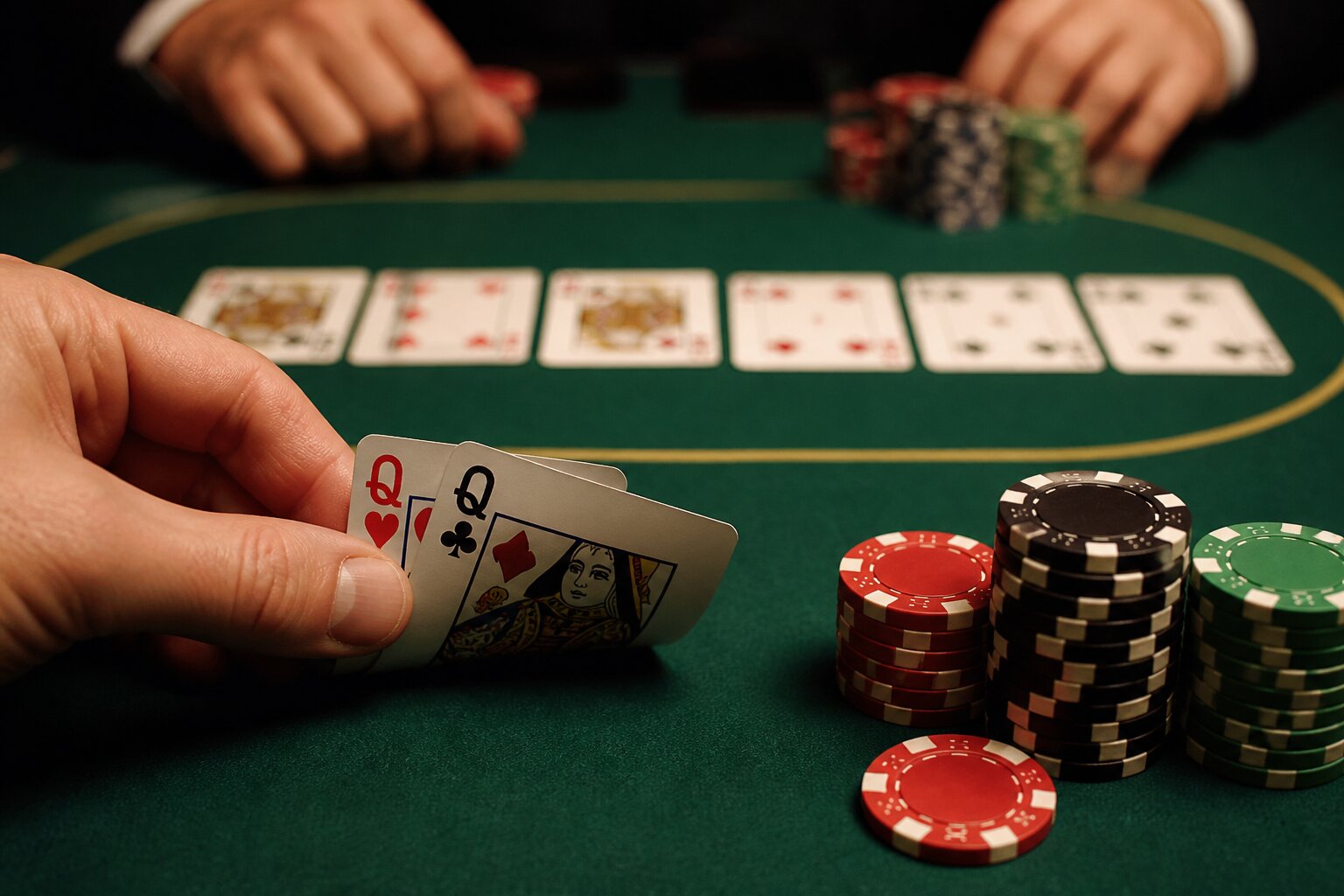
Ever wondered what a "set" means at the poker table? If you’ve heard the term but weren’t sure how it differs from similar hands, you’re in the right place.
Understanding poker terms helps you read hands and make better decisions. This article explains what a set is, shows clear examples, and covers related terms so you can spot and play sets with confidence.
Stick around — each section builds on the last to sharpen your understanding before your next game.
What Is a Set in Poker?
A set in poker is three of a kind made by pairing the two cards in your hand with one matching card among the community cards. For instance, if you hold two 7s and a 7 appears on the board, you have a set of sevens.
A set is specific in how it’s formed: both hole cards are the same rank, and one more of that rank appears on the board. Because you use your pocket pair, sets are often less obvious to opponents than three of a kind built mostly from community cards. That concealment can give you strategic advantages in betting and extracting value.
Poker involves an element of uncertainty, so even a strong hand like a set can be outdrawn. Keep that in mind when reading opponents and sizing bets.
Now that you know what a set is, it helps to see how it contrasts with other three-of-a-kind hands.
How Does a Set Differ From Three of a Kind?
Both a set and three of a kind result in three cards of the same rank, but they differ in composition and how other players perceive them.
A set uses your two hole cards plus one matching community card. Three of a kind can also be made when you have one matching card in your hand and two matching community cards. The latter is often called "trips." Because a set depends on your concealed pair, it tends to be harder for opponents to read; trips are more visible from the board and therefore easier to suspect.
This difference matters for strategy. With a set you can often extract more value because opponents may not expect strength; with trips, opponents might be more cautious or more likely to commit if the board looks strong for multiple players. Reading the texture of the board and typical betting patterns informs whether you press an advantage or proceed carefully.
What Are Common Example Hands for a Set?
Here are a few straightforward examples showing how sets form in play.
Example 1
You’re dealt two 8s as your hole cards. The flop comes with an 8, a 4 and a Jack. You now hold a set of eights.
Example 2
You have two Kings in your hand. One King appears among the community cards. That gives you a set of Kings.
Example 3
Your hole cards are two 3s. A 3 shows up on the turn among the community cards, completing a set of threes.
Each example illustrates the same pattern:
- a pocket pair in your hole cards
- one matching community card appearing on the board
Recognising these situations helps you make better decisions at the table. In particular:
- whether to bet for value when your set is likely best
- when to be cautious because the board could be completing potential straights or flushes
If you’re wondering what to do after hitting a set, the next section explains why they can be powerful and what risks to watch for.
Why Are Sets Important in Poker?
Sets are important because they combine solid showdown value with deceptive strength. Many hands that look strong to an opponent—such as top pair or two pair—are still beaten by a set, yet the set-holder’s concealed pair often keeps opponents in the pot longer.
This concealment allows careful play to extract larger pots: a player holding a set can vary their betting, sometimes slow-playing to build the pot and sometimes betting more aggressively to charge draws. However, sets are not invulnerable. Board developments can turn a set into the second-best hand if a straight or flush completes, or if an opponent makes a full house.
Recognising when the board threatens your set is crucial. When many connected or suited community cards are present, the chance of being outdrawn increases, so players often modify bet sizes or choose to fold earlier than they otherwise would.
With that strategic backdrop in mind, a few related terms will help you talk and think about sets more clearly.
Key Poker Terms Related to Sets
Understanding the vocabulary around sets makes it easier to read hands and discuss strategy. The two most common terms you’ll encounter are set and trips, plus the idea of drawing to a set. Knowing these terms helps you interpret betting patterns and decide whether to commit chips on later streets.
Set Versus Trips: What’s the Difference?
A set is made from a pocket pair plus one matching community card, while trips come from holding a single card that matches two community cards. Both produce three of a kind, but their origins affect how hidden the hand is and how others might perceive it.
A set is often more concealed because only you start with the pair, so opponents are less likely to suspect you. Trips are usually more visible, since two matching cards appear on the board and that can tip off other players. This difference influences how you should size bets and whether to slow-play or extract value.
Drawing to a Set: What Does It Mean?
Drawing to a set describes holding a pocket pair and hoping a matching card appears among the remaining community cards. Players with low or middle pairs often look to set up on the flop because a set typically has strong pot equity against single-pair hands.
Deciding to call or raise to see another card should take several practical factors into account:
- board texture and how likely it is to give opponents straights or flushes
- stack sizes relative to the pot and how much you can win if the set hits
- implied odds, meaning the likely additional money you can extract on later streets if you make your hand
Even with good implied odds, it is prudent to consider how vulnerable a set can be on dangerous boards and whether future betting lines will allow you to realise value.
These terms are useful shorthand at the table and help you plan how to play pocket pairs and respond when an opponent’s betting pattern suggests they might have trips or a set.
Next, let’s clear up some common misunderstandings that can affect decision-making.
Common Misconceptions About Sets
A few persistent myths can lead players into poor choices. Clearing them up improves both hands-on decisions and long-term thinking.
“A Set Always Wins the Hand”
No hand is guaranteed to win. A set can be overtaken by straights, flushes, and full houses. Knowing which board textures are dangerous helps you avoid overcommitting.
“You Should Always Chase a Set”
Chasing a set without regard for odds or pot size can be costly. It’s sensible to weigh the price of seeing more cards against the likely return if you hit. Pocket pairs are valuable, but their play should fit the situation.
“Sets Are Easy for Others to Spot”
Sets are often well hidden because both pocket cards contribute. Still, betting and timing patterns can reveal information, so mixing play and observing opponents’ tendencies remains important.
Keep these points in mind and set clear betting limits before play; that approach supports better decisions at the table.
You’ve now seen what sets are, how they differ from other three-of-a-kind hands, and how to think about them strategically. Use this knowledge to read situations more clearly and make more informed choices in your next game.
**The information provided in this blog is intended for educational purposes and should not be construed as betting advice or a guarantee of success. Always gamble responsibly.