
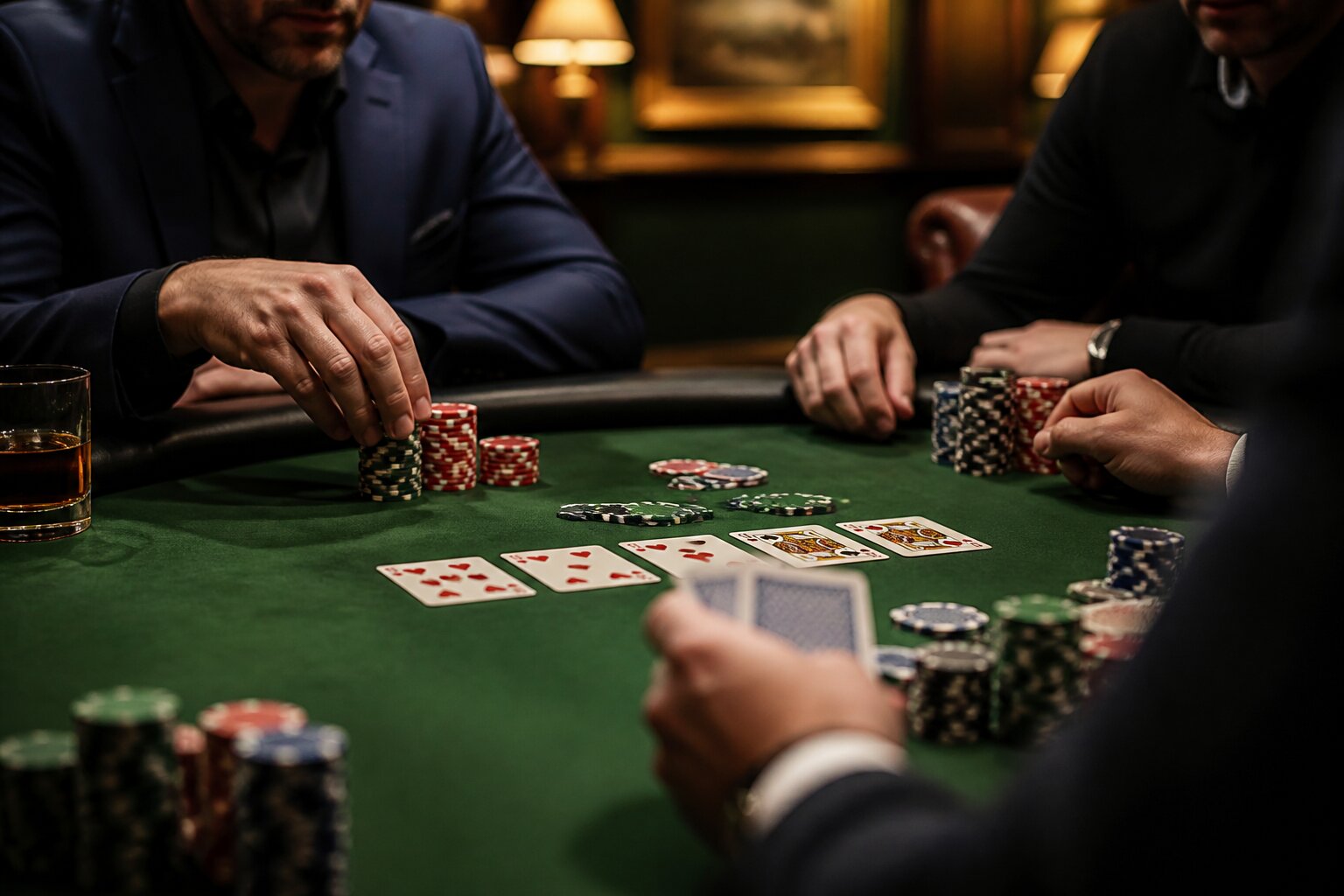
Ever wondered why some poker players seem to anticipate the next move? Or why certain card sequences keep turning up during a session?
Understanding the patterns behind cards and player decisions gives you a clearer view of the game — it’s rooted in mathematics, psychology and observation. In this post we’ll break down common card sequences and the typical behaviours you’ll see at the table, and explain what they can tell you about the play unfolding.
Curious to learn what these patterns mean and how they might sharpen your own reading of a hand? Read on to find out.
What Are Card Patterns in Poker?
Card patterns refer to the ways cards form combinations during play. These combinations — pairs, straights, flushes and so on — are the basic units by which hands are compared.
Each combination has a recognised name and ranking that determines relative strength. Knowing these names makes it easier to judge the potential of your own hand and to anticipate what others might be holding. For example, a straight is five consecutive ranks, while a flush is five cards of the same suit.
Beyond labels, patterns help you follow the flow of a hand. When you recognise that the board already supports a possible straight or flush, you can better judge the likelihood of opponents having completed those combinations and weigh your choices accordingly.
Common Card Sequences Every Player Should Know
Poker uses a standard 52-card deck, and certain sequences are recognised across most variants. Familiarity with these combinations helps you evaluate hands and compare outcomes.
A pair is two cards of the same rank, such as two sevens. Three of a kind means three cards of the same rank, for example three queens.
A straight consists of five cards in sequence, such as 4-5-6-7-8, not necessarily of the same suit.
A flush is any five cards of the same suit — hearts, diamonds, clubs or spades — for instance 2-5-8-10-K of clubs.
A full house combines three of a kind with a pair, such as three jacks and two fives.
Four of a kind is four cards of the same rank, like four kings.
At the top is the royal flush: Ten, Jack, Queen, King and Ace of the same suit. It’s an exceptionally rare combination but serves as the benchmark for highest-ranked hands.
Knowing these sequences is the foundation of reading the table; it lets you assess the board and narrow the range of hands opponents might hold.
How Do Player Behaviours Reveal Patterns?
Players develop habits at the table that can form observable patterns. These behaviours — how someone bets, how quickly they act, even their posture — are part of the social signals you can use to build a reading.
Some players favour aggressive tactics, increasing bets when they sense advantage, while others are consistently cautious and prefer to fold more often. Timing can be revealing too: quick snaps can indicate routine decisions, while pauses may suggest real deliberation.
It’s important to treat these clues as one piece of information among many. Behavioural patterns can change over a session as players respond to wins, losses or table dynamics. Observing tendencies gives context to the cards without guaranteeing any single outcome.
Spotting Repetitive Actions at the Poker Table
At the table you’ll notice repeated actions that become part of a player’s profile. They might routinely make small bets when uncertain, rarely defend blinds, or habitually take long pauses before raising.
Physical habits also show up in small ways: the way a player stacks chips, how they glance at the board, or whether they fold quickly when put under pressure. These small consistencies let you form expectations about how that person will react in similar situations.
Over time these observations build a picture of the table’s dynamics. Rather than treating every occurrence as decisive, combine these behavioural clues with the card patterns you’ve seen to form a more rounded judgement.
Can Analysing Patterns Improve Your Poker Session?
Analysing patterns — both in cards and players — sharpens your awareness of the game. Recognising recurring board textures, or a particular opponent’s betting style, can help you make more informed choices about which hands to play and how to respond.
That said, poker is affected by randomness and variability. Pattern analysis improves decision-making by narrowing possibilities and highlighting likely scenarios, but it doesn’t guarantee specific results. The strength of analysis lies in improving expected outcomes over many hands rather than predicting a single hand’s result.
Use pattern spotting to inform your approach: it can increase the consistency of your decisions and help you avoid predictable mistakes. Combining observation with sound fundamentals—position, pot odds and hand selection—gives you the best chance of steering a session in your favour. Keep limits clear and treat the activity as entertainment.
Myths About Poker Patterns: What Should You Ignore?
There are several persistent myths around poker patterns that are worth dismissing. One is the idea that spotting a pattern will ensure a win; no behavioural cue or sequence of cards can promise a particular outcome every time.
Another common misconception is that copying an opponent’s style will automatically succeed. Poker is situational: what works in one context may fail in another because opponents, stack sizes and board cards differ.
Be wary of claims about secret systems or guaranteed methods. Instead, focus on building a flexible approach that combines pattern recognition, sound strategy and bankroll discipline. Accepting that uncertainty can’t be eliminated helps you make clearer, less emotionally driven choices.
Reading Opponents: What To Look For In Behaviour
Watching opponents gives you useful context for decisions, but it’s best treated as probabilistic information rather than proof. Below are key behavioural areas and what they typically indicate.
Betting Habits
Watch the size and frequency of bets. Consistent large bets can indicate aggression or an attempt to protect a strong hand, while frequent small bets may show caution or an attempt to control the pot size. Over multiple hands, these tendencies reveal whether a player is inclined to pressure the table or to avoid confrontations.
Body Language
Physical cues can offer extra information. Fiddling with chips, avoiding eye contact, or changing posture occasionally accompany emotional states, though they are not definitive. Use body language to supplement betting patterns and hand histories rather than as a standalone read.
Reaction to Wins and Losses
Players often change tempo after an important win or losing streak. A confident streak might lead to looser play, while a player who has just lost several hands may become more conservative. Noting these shifts can help you anticipate adjustments in their strategy.
Keeping these observations balanced with card-based information is the most reliable way to read opponents. Play remains a mixture of skill and unpredictability, so treat behavioural reads as part of a wider decision-making process and keep your stakes and session goals under control.
Final thought: paying attention to both card sequences and player habits adds depth to your understanding of poker, helping you make calmer, more consistent choices at the table.
**The information provided in this blog is intended for educational purposes and should not be construed as betting advice or a guarantee of success. Always gamble responsibly.