
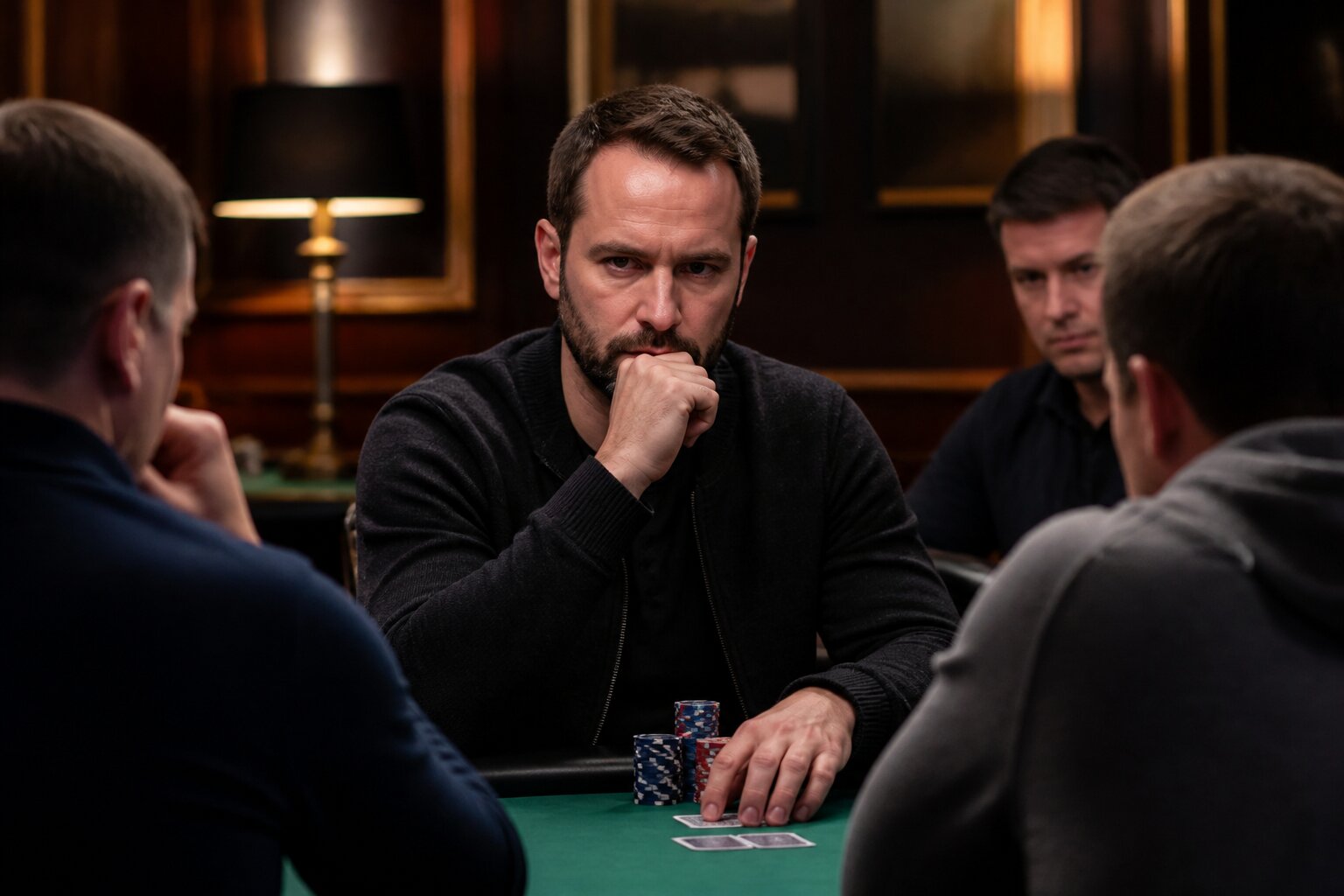
Ever found yourself at the poker table facing a big bet and wondering if your opponent is bluffing? You might have heard the term hero call and felt the urge to know what makes one truly justified.
Hero calls are some of the most dramatic moments in poker because they force a clear read on the opponent and the situation. This guide explains what a hero call is, examines memorable examples, and shows how to judge those high-pressure moments with more confidence, whatever your experience level.
What Is a Hero Call in Poker?
A hero call is when a player calls a large bet or an all-in, often on the final betting round, holding a hand that is not especially strong. The decision rests on the belief that the opponent is bluffing or overrepresenting a hand, based on how the hand was played.
These calls are not reckless gambles. Successful hero calls are grounded in observation: betting patterns across the hand, how the opponent has acted in similar spots, and whether the narrative the opponent presents fits the board. In live games, physical tells can add information, while online play requires closer attention to timing and bet sizing.
A sound hero call combines evidence and restraint. It is a targeted, situational decision rather than a default tactic.
Why Do Players Make Hero Calls?
Players make hero calls for strategic and psychological reasons. Strategically, a well-timed call undoes an opponent’s attempt to steal a pot and can punish habitual bluffers. Psychologically, calling can signal to the table that you are not easily pushed around, which can alter opponents’ future behaviour.
That said, emotion plays a role. Ego and the desire to prove reading skills can push players toward questionable calls. Good players balance the potential table image benefits with the immediate risk to their stack, relying on logic rather than impulse.
Keeping decisions grounded in the hand’s story reduces costly mistakes and helps preserve long-term staking discipline.
What Are the Key Signs to Consider Before Making a Hero Call?
Before committing to a hero call, take time to weigh several factors that together build the case for or against calling. Treat the decision as a balance of evidence rather than a gut reaction, and remember that even a well-reasoned hero call can be wrong.
1. Opponent’s Betting Patterns
Evaluate how the opponent has bet from preflop to river. Look for consistency in sizing and frequency: steady patterns are more likely to represent genuine holdings, while abrupt changes can be suspicious.
Pay attention to how the opponent constructs their story with bets. A line that does not make sense — for example, a player who checked early streets and suddenly bets big on a safe board — can be a strong indicator of deception.
2. Your Opponent’s Behaviour
In live play, non-verbal cues may add useful context, while online you will look for timing patterns. Small tells such as unusual hesitation, a sudden change in aggression, or repeated quick checks can all be informative.
Treat these signals as corroborating evidence rather than proof. Behavioural reads help build a picture, but they should be combined with betting patterns and board texture before you act.
3. Your Own Hand Strength
Assess honestly how marginal your holding is. If your hand only beats a tiny range of bluffs, you need much stronger supporting evidence to justify a hero call.
Consider how your hand plays against likely value ranges as well as bluffs. A marginal hand that has good showdown value or blockers to key combinations can be more defensible than one that does not.
4. Table Dynamics
Consider the opponent’s overall image and recent history at the table. A player who has been caught bluffing frequently will have a different likelihood of bluffing in future spots than someone who has been isolating and value-betting consistently.
Also factor in meta-game elements such as seat position, recent confrontations between you and the opponent, and how other players are reacting. These contextual details can shift the balance of probability.
5. Pot Odds
Compare the cost of calling with the pot size to judge the immediate mathematical justification. If the potential payoff is small relative to the risk, that tilts the decision toward folding even when a bluff is possible.
Remember to include implied odds and reverse implied odds where relevant. Even when pot odds alone are marginal, the wider monetary context of the hand can influence whether a hero call is sensible.
Together, these elements form the evidence required to justify a hero call. No single sign should carry the decision on its own; combine patterns, behaviour, hand value, dynamics and odds to reach a considered conclusion.
Common Mistakes When Attempting a Hero Call
One frequent error is overconfidence, assuming reads are more reliable than they are. Players can place too much weight on a single tell or a few hands of observed behaviour, then act as if they have near certainty. That kind of certainty is rarely justified and can lead to repeated costly mistakes.
Misreading opponents is another hazard. This can take several forms:
- Seeing bluffs where there are none, and calling down into strong hands.
- Ignoring clear signs of strength because emotion or wishful thinking skews judgement.
- Over-interpreting minor gestures or timing as definitive evidence of a particular holding.
Chasing losses or trying to win back a streak of bad hands leads to poor calls. Other related unhelpful behaviours include:
- Treating hero calls as a way to build a reputation rather than as a single, situational decision.
- Letting pride or ego drive choices instead of objective assessment.
- Failing to consider pot odds, stack sizes and tournament stage when making a call.
Practical discipline helps prevent these mistakes and supports better long-term results. Useful measures include taking regular breaks when frustrated, setting loss and session limits, keeping notes on opponents rather than relying on memory alone, and reviewing hands afterwards to learn from errors. If you feel emotions are affecting your judgement, step away until you can make clear-headed decisions.
Play responsibly and be mindful of bankroll and limits when attempting advanced strategies such as hero calls.
How to Recognise When a Hero Call Is Worth It?
Recognising a justified hero call starts with how coherent the opponent’s story is. If their actions across the hand do not form a consistent narrative with the board, that mismatch can be telling.
Opponent tendencies matter too. When a player has shown a pattern of bluffing in comparable spots, that shifts the balance toward calling. However, even strong evidence can be misleading; good judgement accepts uncertainty and values bankroll preservation.
If the expected value of calling, judged against pot size and likely ranges, is unfavourable, folding is often the correct choice. In close spots, restraint is usually the wiser long-term strategy.
Will Making a Hero Call Affect Your Table Image?
A successful hero call can change how other players see you. It often makes opponents more cautious about bluffing you in future hands, since they know you are willing to make tough decisions when the situation warrants it. That caution can reduce the number of cheap bluffs you face and make later value bets more profitable.
Conversely, repeated failed hero calls can give you a reputation for being overaggressive. Other players may start to target you more often with value bets or bluff you more frequently, expecting you to make risky calls. That can lead to tougher spots and bigger losses if you do not adjust.
Table image is something to keep in mind, but it should not be the main reason for any single call or fold. Decisions grounded in the specific hand, the board, the betting patterns and your opponents' likely ranges are more reliable than moves made primarily to craft a reputation.
A single memorable hero call can be useful and can change perceptions at the table for a while. Nonetheless, long-term success comes from consistent, sound decision-making rather than occasional spectacular plays. Maintain a balanced approach and adapt your strategy based on real information rather than solely on how you want to be seen.
The Role of Psychology in Hero Calling
Psychology influences both the bettor and the caller. Players shaping a false story with their bets try to exploit opponents’ tendencies, while the would-be caller interprets those signals under time pressure and emotional strain. That interpretation is affected by prior history, table image and recent outcomes, all of which can bias decision making.
Ego, fear of missing a big moment, or the desire to “prove” a read can interfere with clear thinking. These impulses often appear quickly and feel convincing, yet they can push a player into making an ill-advised hero call. Recognising those urges early gives you a chance to pause and reassess the actual evidence.
Conversely, disciplined mental habits reduce costly errors. Useful habits include:
- steady focus during hands and avoidance of distractions,
- emotional control after wins or losses so results do not colour judgment,
- willingness to fold when the evidence for a call is weak rather than forcing action.
Hero calling is therefore as much about managing one’s own mind as it is about reading others. Being aware of cognitive biases and practising restraint will improve long-term decision making and bankroll health.
Gamble responsibly. If you are concerned about your gambling or that of someone you know, seek advice from a recognised support organisation.
Famous Hero Call Examples at the Poker Table
- Analysing the Thought Process Behind Each Example
Studying well-known hero calls clarifies the reasoning that can justify a big call. These hands show how observation, pattern recognition and narrative analysis combine under pressure to produce a decision that can be defended afterwards.
They are valuable as instructive cases rather than scripts to copy. The specific table dynamics, opponent tendencies and stack sizes matter in each instance, so the examples should be used to learn principles rather than to suggest a fixed play for all situations.
Chris Moneymaker vs. Sam Farha – 2003 WSOP Main Event
Moneymaker’s river call with only king high followed a careful assessment of Farha’s betting sequence and the board texture. He considered how the hand had developed on each street, the sizes of the bets and what range Farha would need to hold to bet in that way.
Moneymaker also weighed Farha’s tournament image and previous actions at the table. Those elements made the line Farha took less consistent with a strong made hand, so calling became the most consistent interpretation of the overall story.
Phil Ivey vs. Paul Jackson – Monte Carlo Millions 2005
Ivey’s call with a high card was informed by Jackson’s aggression and the timing of his bets. Rather than relying on a single physical tell, Ivey used a pattern of moves accumulated over the session to form a read.
Timing, bet cadence and the sequence of raises gave Ivey information about what Jackson’s range was likely to include. The call reflected a synthesis of behavioural observation and logical range deduction.
Davidi Kitai vs. Ole Schemion – EPT Berlin 2012
Kitai combined careful range analysis with an understanding of Schemion’s tendencies to make a decisive call. He examined which hands in Schemion’s range would carry out the particular line taken, and how plausible a bluff was across that range.
His reasoning emphasised the mathematical plausibility of a bluff and the consistency of actions, illustrating how probability and observation work together to justify a call.
Each example underlines that careful thought, not bravado, is the basis for effective hero calls. They show how evidence and logic, rather than hope, should drive large, high-pressure decisions at the table.
Myths About Hero Calls You Should Ignore
Several persistent myths cloud judgement at the table. One is that hero calls automatically demonstrate superior skill. In truth, a lone successful call says little about overall decision quality; consistent, well-founded choices matter more.
Another myth is that hero plays are only for professionals. While experience helps, anyone can encounter situations where a call is justified. The key is learning to assess evidence logically rather than treating hero calls as a badge of honour.
Also ignore the idea that hero calls are about chasing excitement. Responsible play means sizing risk to what one can afford and treating poker as a strategic endeavour.
By dispelling these myths, players can focus on sober analysis and better long-term outcomes.
How Can You Practise Making Better Hero Calls?
Developing better hero call instincts comes from low-risk practice and thoughtful review. Free online games and play-money formats let players explore scenarios without financial pressure. Reviewing hand histories, whether your own or others, helps identify where a read was supported by the facts and where it was not.
Emphasising learning over immediate wins encourages steady improvement. If competitive money play is involved, using tools to manage losses and set sensible limits helps keep decisions clear-headed. For further help and support with safer gambling, resources such as BeGambleAware and GamCare offer guidance and assistance.
Practice, analysis, and discipline create the most reliable pathway to making sound hero calls.
Final note: hero calls reward careful observation, patience, and clear thinking. When the evidence aligns and the risk is justified, a well-timed call can shift the dynamic at the table; when it does not, restraint preserves your ability to play another day.
**The information provided in this blog is intended for educational purposes and should not be construed as betting advice or a guarantee of success. Always gamble responsibly.