
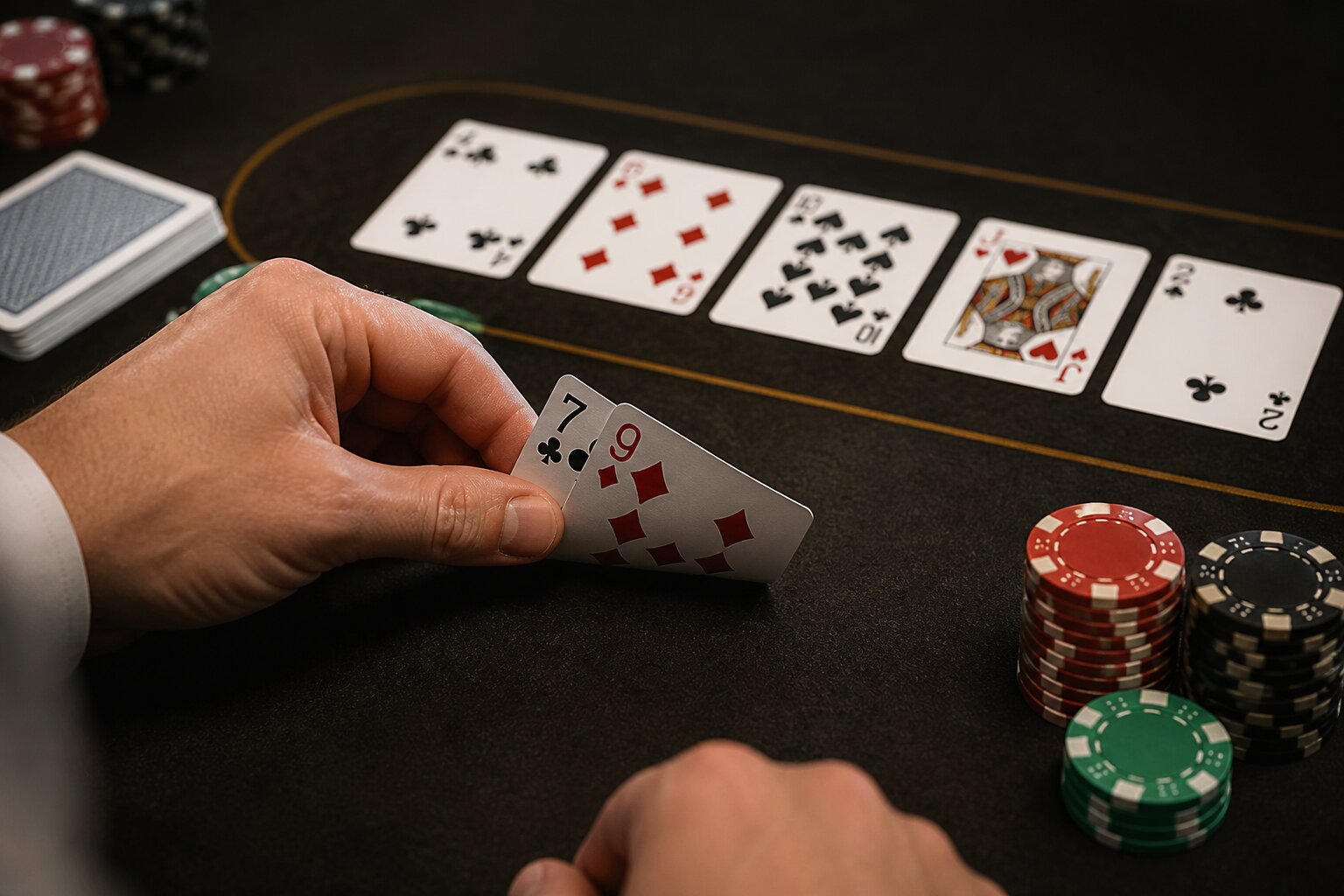
Ever found yourself on the edge of your seat, waiting for just the right card to fall in a game of poker? You might've been hoping for what's known as a "gutshot"—one of the most tense and decisive chances in any hand.
Gutshot straight draws turn a hand’s prospects on a single card and force choices about whether to continue. If you want to know how they form, when they matter and how to spot them at the table, this guide walks through the essentials and the finer points.
Keep reading to see clear examples, the maths behind the draw, and practical ways to recognise them during play.
What Is a Gutshot in Poker?
A gutshot, also called an inside straight draw, happens when your cards and the community cards form a sequence that is missing a single rank in the middle. Only one rank — with its four suits — will complete the straight.
They have a few defining features:
- only one rank will complete the straight, giving you four outs in a full deck,
- the missing card is in the interior of the sequence, rather than at either end,
- they are less flexible than open-ended straight draws because fewer cards can improve your hand.
For example, if you hold 5 and 6 and the flop shows 4 and 8, only a 7 will finish the straight. That single-rank requirement is what makes the draw an inside or gutshot draw.
Because gutshots offer fewer outs, they tend to be weaker than open-ended draws and should be weighed alongside other factors such as your position, the size of the pot, the likely strength of opponents' hands, and the betting action. In many situations a gutshot will be most valuable as part of a combined draw or when the potential payoff justifies the risk.
Understanding Gutshot Straight Draws in Poker Hands
Gutshot draws differ from other straight-building possibilities because they offer only one rank as a solution rather than two. They can appear after the flop or the turn, and recognising them helps you judge the hand’s potential.
When a gutshot is present, the draw itself should be weighed alongside factors such as the number of opponents, the size of the pot and the likely ranges of other players. A gutshot that appears in the context of weak opposition and a favourable pot may be worth continuing; in a heavy betting environment it often requires greater caution.
Pay attention to how the board interacts with possible straights and other strong hands — that context is what turns a mathematical chance into a sound decision.
When Can a Gutshot Straight Draw Occur?
A gutshot can appear at any stage where community cards are revealed, most commonly after the flop or following the turn. It arises when your own cards and the shared cards form a near-sequence with only one missing rank in the middle.
For instance, with 3 and 6 in your hand and community cards of 4 and 5, a 7 would bridge the gap. Likewise, hands such as 7 and 8 combined with a flop of 5 and 10 leave only a 9 to complete a straight.
Because they can form at different points in a hand, gutshots often change the plan mid-hand: what looked like a bluff or a marginal holding can gain value if the right card appears.
How Does a Gutshot Compare to an Open-Ended Straight Draw?
Both gutshots and open-ended straight draws are routes to a straight, but their chances differ. An open-ended draw can be completed by a card at either end of the sequence, giving two ranks that help you; a gutshot offers only the one middle rank.
For example, holding 5 and 6 with 7 and 8 on the board is open-ended (a 4 or a 9 helps). Holding 6 and 9 with 7 and 8 on the board is a gutshot — only a 10 completes the straight.
That difference in available ranks affects your probability of hitting and should influence how you react in the betting. The comparison matters most when you’re deciding whether the potential payoff justifies the risk.
Common Myths About Gutshot Draws
There are a few repeated misunderstandings about gutshots that can mislead players. One is treating a hit as a sign of exceptional fortune; in fact, hitting is a matter of probability based on remaining cards.
Another is believing that chasing a gutshot is always poor or always sensible — the reality is situational. The strength of your opponents’ ranges, pot size and position all shape whether a gutshot is worth pursuing.
Finally, some think previous failed attempts change the current draw’s odds. Each deal is independent and the underlying probabilities stay the same regardless of past outcomes.
Clearing up these myths makes it easier to treat gutshots as one element of solid decision-making rather than an emotional bet.
Why Are Gutshot Draws Important in Poker?
Gutshot draws matter because they alter the value of a hand and the choices a player faces. They show up frequently enough that being able to recognise and evaluate them improves your overall play.
Beyond the immediate chance of improving, a gutshot can influence opponents’ perceptions and affect the flow of bets. For instance, representing a completed straight when you haven’t hit can win a pot; conversely, being too attached to a lone gutshot can lead to avoidable losses.
Understanding gutshots encourages a broader view of the table: you learn to combine card analysis with reading the pot and opponent tendencies, which leads to clearer, more measured play.
How to Identify a Gutshot Hand at the Table?
Identifying a gutshot begins with lining up your cards and the community cards and looking for a single missing rank in the middle of a potential straight. That visual check is the simplest method.
Consider also how many players are in the pot and what hands they might hold. A gutshot that completes a straight on the turn or river may still leave you behind if another player can make a stronger hand from the same board.
Taking a moment to assess the broader situation — rather than focusing only on the draw itself — makes the difference between a well-judged continuation and an ill-advised call.
Typical Scenarios for Gutshot Straight Draws
Gutshots commonly occur in routine Hold’em situations and can be generated by many different starting hands. A clear, often-cited example is being dealt 4 and 7 and seeing a flop of 5 and 6; only an 8 helps to complete the straight.
Other typical examples include:
- Holding middle-connected cards such as 8 and 10 with a flop showing 9 and Queen; a Jack is the single missing rank that completes the straight.
- Coming to the turn with an apparent gap in sequence where one rank remains to finish the straight, so the draw only materialises after the river card appears.
These scenarios recur frequently enough that familiarising yourself with the pattern helps you spot them quickly and factor them into your in-hand decisions. Pay attention not just to the raw outs but also to the betting dynamics, position and the likelihood opponents hold stronger made hands, and keep stakes and risk in proportion to your budget.
Gutshot Probabilities: What Are the Odds?
Knowing the maths behind a gutshot gives a realistic picture of what to expect and how to weigh the draw. After the flop in Texas Hold’em there are usually four cards that complete a gutshot — one for each suit — out of the 47 unseen cards.
That produces roughly an 8.5% chance to hit on the turn. If you consider both the turn and the river, the combined probability rises to about 16.5%.
These numbers are tools for judgement. They should be used with an understanding of pot odds and opponent behaviour to decide whether continuing is justified.
Calculating Your Draw Chances
To be specific, the single-card chance on the next street comes from dividing the number of outs (four) by the number of unseen cards (47 after the flop). For the two-card window, the calculation looks at the chance of not hitting on either card and subtracts that from one, which yields the approximately 16.5% figure mentioned above.
These calculations help place the draw in context with betting and pot size; when the potential reward outweighs the probability-adjusted cost, pursuing the draw can be reasonable.
Frequently Asked Questions About Gutshot Poker
Gutshot straight draws raise a few common queries from players at all levels. Below, these questions are answered clearly and concisely.
What is a gutshot straight draw?
A gutshot straight draw, or inside straight draw, appears when you need one specific card rank that fits in the middle of a near-sequence to complete a straight.
How often do gutshot draws complete?
With one card to come, the chance is roughly 8.5%. With two cards to come, the combined chance is about 16.5%. These figures are statistical probabilities for planning, not guarantees.
Is chasing gutshot draws recommended?
Whether to continue with a gutshot depends on pot size, opponent action and your position. Assess these factors rather than relying on a single rule for all situations.
Can anyone play gutshot poker hands?
You must be at least 18 to play poker for real money in the UK. If you choose to play, set clear limits and stick to them so the game stays a controlled and enjoyable activity.
Final thought: gutshot draws are a compact but important piece of poker judgement — learn to spot them, understand their odds and fold them into the wider picture of the hand.
**The information provided in this blog is intended for educational purposes and should not be construed as betting advice or a guarantee of success. Always gamble responsibly.